-
Breakfast Podcast
Four of us talk all things breakfast!
-
Oxbridge man vows to appeal guilty verdict as he’s sentenced to four years in prison for arson
A man from Oxbridge has been sentenced today to four years in prison by Oxbridge Crown Court after being found guilty of arson, following a blaze that started in his own flat.
The jury heard how Thomas Beasley, 59, unemployed, of Mountain Street, was alleged to have started the fire deliberately after drinking a substantial amount of alcohol.
He was found guilty by a majority verdict of 10-2 after the jury heard how Station Officer Howard Keel, the officer in charge at Oxbridge Fire Station, gave evidence and said: “The fire had started in a pile of papers and curtain material in the middle of the living room.
“It looked like it had been deliberately gathered there, although the rest of the room was a real mess with rubbish and beer cans strewn across the floor.”
Mr Beasley pleaded not guilty to arson, claiming that the fire had been started accidentally by a faulty light, however this was dismissed by Mr Keel who claimed that the faulty light was too far from the combustible materials to have been the cause.
Mr Keel said: “It would be a thousand to one chance of it causing the fire.
“My view is that whether deliberately or accidentally, someone put a light to that pile of material.”
The verdict follows four previous convictions for Mr Beasley for arson, including two years in prison for setting fire to his previous flat.
Judge Guy Kearl QC said: “It is quite clear Mr Beasley that you are a danger to yourself and the wider public when you have been drinking.
“This time you nearly killed yourself – next time it could be other people.”
After the verdict was delivered, Mr Beasley vowed to appeal the conviction.
-
Oxbridge youths sentenced after stealing from vulnerable woman
Two youths from Oxbridge have been sentenced today by Oxbridge Youth Court after they admitted stealing £800 in cash and valuables from a local elderly woman.
The court heard how the youths – who cannot be identified for legal reasons – knocked at the door of Mrs Batilda Bathurst in Heaton Avenue, Oxbridge, claiming to be desperate to use the toilet.
Miss Sayeeda Tai, the prosecuting solicitor, said: “Mrs Bathurst, although a little apprehensive about this, felt it was easier to let them use the facilities and get them on their way.
“However, when they didn’t come downstairs after a few minutes had passed, she climbed the stairs to find the two rummaging through drawers in her bedroom.”
The court heard how the two youths, aged 15 and 16 years old, ran from the house when confronted, and Mrs Bathurst found a necklace worth £500 and £300 in cash to be missing.
They were later found by police at a local shopping centre, where they were trying to buy video games.
Mrs Juliette Hicks, the solicitor for the 16-year-old, told the court how her client came from a troubled background, and had an unsettled home life.
Mr Arnold McNae, the solicitor representing the 15-year-old, said: “My client is deeply sorry for what was a moment of madness.
“He comes from a good home.”
The presiding magistrate, Mr Simon Pollard, took the two differing backgrounds into consideration when delivering the verdicts, with firmer action being taken against the 16-year-old.
The 16-year-old was given a detention training order for four months, with two months in custody and two months supervised in the community.
Mr Pollard said: “We are sorry to take this step but we feel it might break the cycle of offending that has been taking place.”
The 15-year-old was given a youth rehabilitation order requiring twenty hours of unpaid community work.
Mr Pollard said: “We appreciate this is a first offence and that you have shown true remorse but this was also a mean-spirited crime committed against a vulnerable old lady.”
-
Police hunt for local man after suspicious death in Horsforth
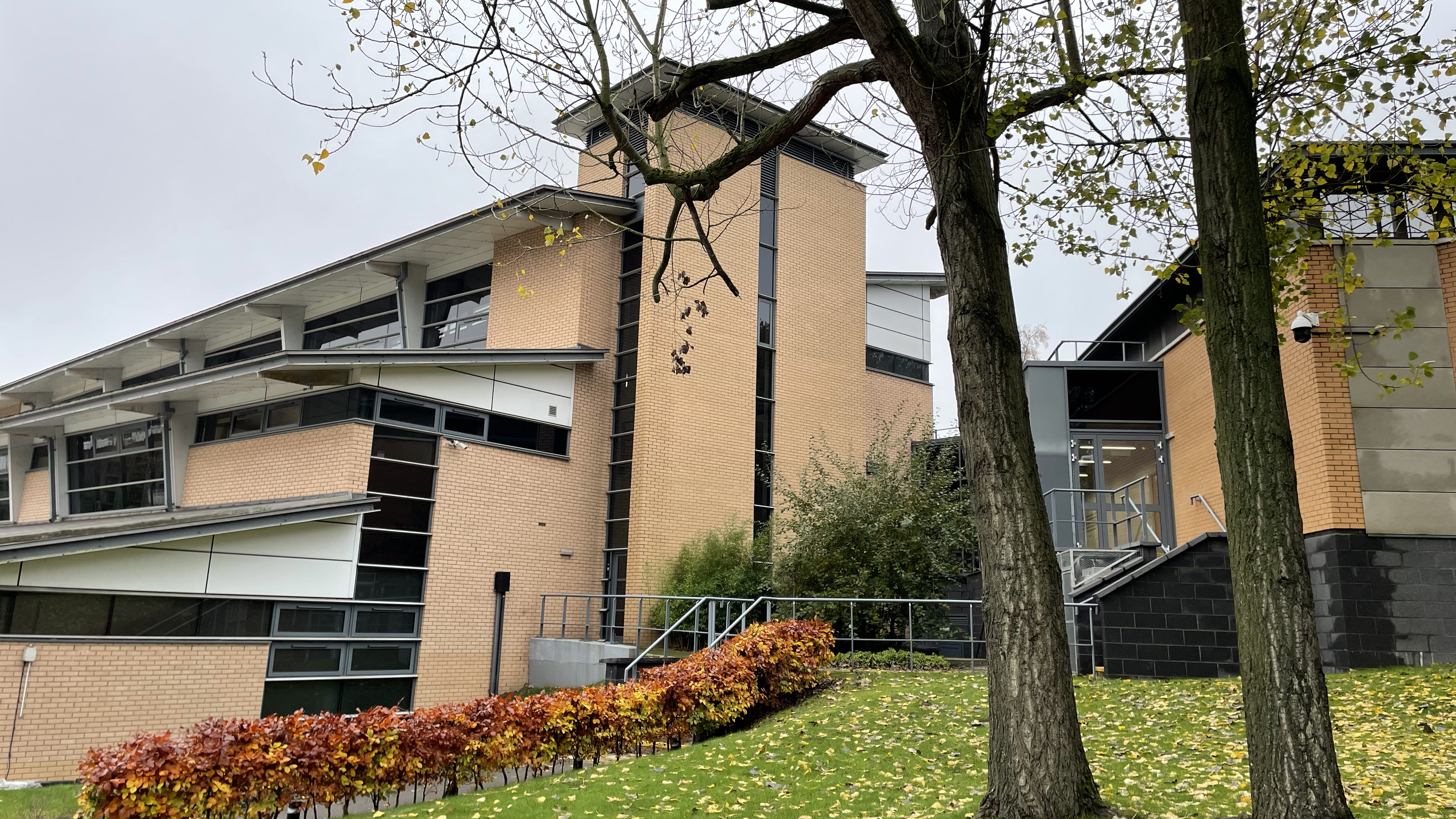
Tyker University, on Brown Lane, Horsforth, where the body was found West Yorkshire Police have issued a warrant for the arrest of a local man after 40-year-old Dr Andrew Gregson was found dead last night at Tyker University.
The body was found by a cleaner at the university, with police confirming that the post-mortem found the cause of death to be blunt force trauma to the head.
Police are looking for 36-year-old Ashley Cartwright, who is employed by the university.
He is described as approximately 170cm tall, white, slim with brown hair and stubble, and was last seen wearing a green parka-style coat and jeans.
Police have asked the public not to approach him but to call 999 if they know of his whereabouts.
Detective Inspector Susan Eccles, speaking at a press conference this morning, said: “North Leeds CID want to speak to Ashley Cartwright in connection to the investigation.
“He was last seen on Tyker Campus on the evening of Dr Gregson’s death.”
When asked if there was any known relationship between the victim and the suspect, she replied: “All we know is that they were acquainted.”
The police don’t believe there to be any risk to the public from any further attacks, and the suspect was not already known to them.
Dr Gregson was a lecturer in criminology at Cambridge City University but was a regular guest speaker at Tyker University.
He leaves a husband and their young son.
Tyker University will hold a memorial service for Dr Gregson this Friday at noon in the chapel.
Anybody with any information is urged to contact the police on 999.
Alternatively, contact the independent crime-fighting charity Crimestoppers anonymously on 0800 555 111 or through their anonymous online form at www.crimestoppers-uk.org.
-
Block! Media insiders give their advice on how to handle online trolls

Journalism and Media Week at Leeds Trinity University has seen broadcasters and media professionals give advice to students on how to stay safe online.
The annual event returned last week for its fourteenth year, with a packed line-up of speakers including TV and radio presenter Jeremy Vine and showbusiness journalists Katie Hind and Boyd Hilton.
Students were given the opportunity to quiz the guests, and social media was the number one theme as they looked for guidance on the way that it has changed working in the industry.
Katie Hind, Consultant Showbiz Editor at Mail Newspapers, described how sites such as Twitter have enabled celebrities to talk directly with their audience, but with this comes the opportunity for them to face abuse.
When asked how she deals with this herself, she was defiant in her response, asking: “Why should I have to change how I behave because other people can’t behave properly?”
“It’s really unfair and it can drive you absolutely mad,” she added.
“One of my colleagues gets trolled a lot and she gave me her settings, and so now I don’t see any of it.”
Noa Hoffman, Political Reporter at The Sun, had a simpler response: “Block!”
She believes that being open to abuse on social media is a part of the job, but as soon as she reads a tweet that is negative about her, she blocks the account so she doesn’t see anything else the writer says.
It’s not all bad though – several of the contributors described the benefits that social media has brought to the industry.
Alice Taylor, Associate Producer of Tonight on ITV, explained how social media has made it easier to find contributors to their investigations, whilst photographer Lisa Stonehouse explained the potential of using social media as your online portfolio for work.
With Twitter’s new owner Elon Musk making large numbers of employees redundant, it remains to be seen whether there will be any improvements to online safety in the near future.
-
The day the Olympic Torch passed through Brough

The Olympic Torch passing through his home village sparked a slightly-higher-than-indifferent reaction from Horsforth student Caleb Canet-Baldwin, 18.
It was a sunny but cold day in Brough in 2012, and the then eight-year-old Caleb waited eagerly with his family and friends as the local community gathered on the streets.
“There was an air of suspense as people were waiting for it,” said Caleb, recollecting the moments before the torch appeared.
“I didn’t realise there were that many people there.”
Amongst the crowds was Caleb’s dad, who had dragged a set of drums out onto the street ready to herald the arrival of the flame.
The event had been hyped up on local radio and so he had wanted to contribute to the atmosphere, however in the end, Caleb describes how he “smacked a drum with a drum stick every now and then.”
Whilst not excited to begin with, Caleb says that the passing through of the torch gave him a renewed interest in some of the Olympic events that summer.
“I would be lying if I said it didn’t affect me,” he said.
“It was nice to see it pass where I’m from. It motivated me to get better at sports.”
On reflection, Caleb says that whilst the occasion may not have been a major turning point in the history of Brough, he thinks that it was important for those who were that and gave “some recognition that they exist.”
-
5 reasons Putin might be doing what he’s doing right now
1. He wants to rebuild the Soviet Union

Map of Soviet Union Russia, Ukraine, and other countries in the region were part of the Soviet Union which was broken up in the early 1990s. Controlled from Moscow and heavily Russia-dominated, the Soviet Union was a collection of nation states that collectively were powerful and influential in a world plagued with conflict. As it ended, so did the standing and power that Russia had, and Putin may want to regain this as a show of strength towards the rest of the world.
2. He wants to protect Russian trade

BBC map of invasion into Ukraine Geographically, whilst Russia is huge it has challenges when it comes to trading with the rest of the world. To the north, its coastline is frozen for most of the year. Most of the rest of its border is with other countries. Their invasion through the east and south of Ukraine towards Crimea gives them access to potential warm water ports, opening up more trade opportunities rather than having to transport goods through potentially hostile foreign countries.
3. He fears NATO being on his doorstep

Nato meeting – June 2022 Putin reportedly sees NATO as an alliance of the West that wants to eventually destroy Russia. He has previously accused NATO of breaking promises, saying that they pledged not to expand eastwards towards Russia and then did so anyway. Ukraine has signalled its interest in recent times to join NATO themselves, which would place a NATO member along a large stretch of Russia’s border.
4. He’s unwell

Having just turned 70, there are rumours about Putin’s health, including suggestions it is deteriorating rapidly. This may be impacting his judgment and leading him to make irrational decisions.
5. He’s just a dick

Often the simplest reason is the real one, and inflicting suffering on innocent civilians maybe can’t be explained rationally. He has previously been accused of meddling in the politics of other countries with the aim of destabilising them. Maybe he just enjoys the chaos.
-
Subscribe
Subscribed
Have a WordPress.com account? Log in now.

